

KPI Checklist: Take Control of Your Logistics
Missed shipments, rising costs, and endless back-and-forth with logistics partners can turn a thriving business into a constant firefight. When every package and every order counts, guessing how your supply chain is performing isn’t enough. Imagine having a clear view of every moving part, knowing exactly what’s working, and spotting inefficiencies before they snowball.
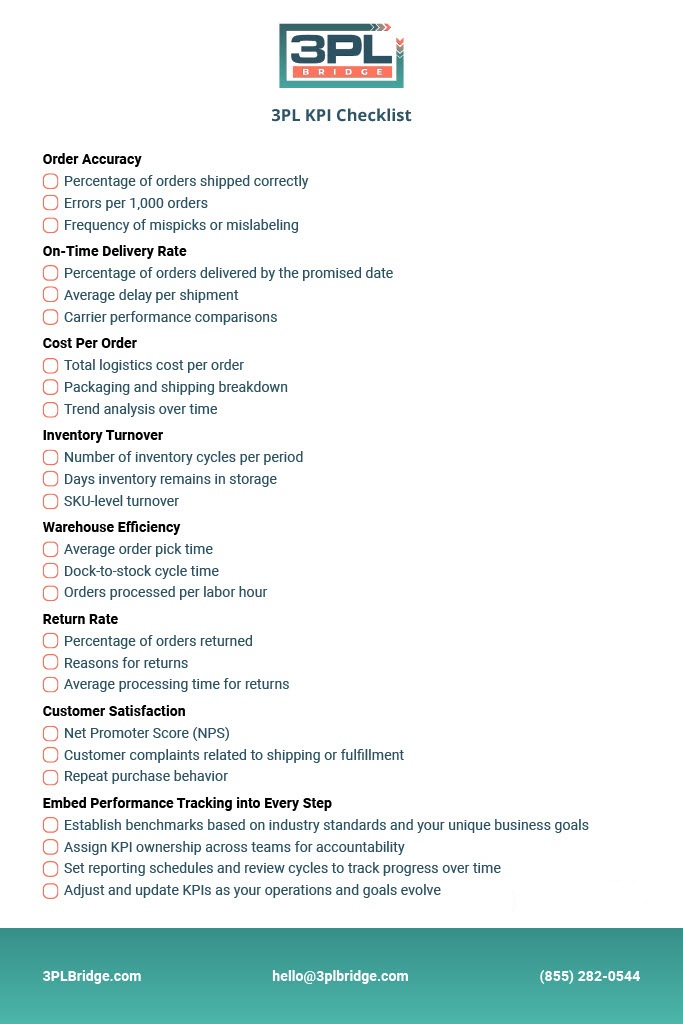
The KPI Checklist from 3PL Bridge gives businesses that perspective, tracking the most important metrics, uncovering hidden opportunities, and providing a roadmap to smoother, faster, and more profitable operations. Take control of your logistics and make every metric meaningful by partnering with 3PL Bridge today.
Get a Free, Detailed Quote
Tell us about your business
Turn Supply Chain Chaos into Clarity
Logistics operations involve many moving parts, and without clear benchmarks, it’s nearly impossible to know if your supply chain is performing optimally. Our KPI checklist brings focus to the most critical areas of your operations:
- Provides measurable targets for your logistics partners
- Ensures alignment between internal teams and external 3PL providers
- Highlights inefficiencies before they impact costs or customer satisfaction
- Supports strategic decision-making for growth and scalability
When your business operates with defined KPIs, decisions are no longer guesses. You can quickly spot patterns, address problems, and take action to improve operations. Our KPI checklist also encourages accountability and creates a shared language between your team and logistics partners, making collaboration more effective and productive.

The Metrics That Move Your Business Forward
Every logistics operation has unique challenges, but some metrics are universally essential. These KPIs form the foundation of our checklist:
Order Accuracy
Ensuring that customers receive the right products in the right quantities is fundamental. Even minor mistakes, like sending the wrong size or color, can lead to returns, complaints, and lost trust. By measuring order accuracy consistently, businesses can identify trends in fulfillment errors and address them before they escalate into larger problems.
Key measures include:
- Percentage of orders shipped correctly
- Errors per 1,000 orders
- Frequency of mispicks or mislabeling
Accurate orders also impact cost control. Fewer errors mean fewer resources spent on replacements and fewer disruptions to warehouse workflow. By improving accuracy, businesses enhance customer satisfaction while reducing hidden operational costs.
On-Time Delivery Rate
Delivering orders on schedule is critical for customer trust and retention. The on-time delivery rate shows the percentage of orders that arrive as promised, highlighting delays that may occur due to transportation, processing, or communication issues.
Key measures include:
- Percentage of orders delivered by the promised date
- Average delay per shipment
- Carrier performance comparisons
Tracking on-time delivery not only protects your brand reputation but also provides insight into operational bottlenecks. If delays occur frequently, you can analyze root causes, whether it’s a shipping partner, warehouse process, or forecasting error, and implement improvements that prevent future issues. Transform your supply chain into a smooth, predictable operation by working with our team now to track the metrics that drive real results.
Cost Per Order
Every business wants to know the true cost of fulfillment. Cost per order calculates total logistics expenses divided by the number of orders processed, covering labor, packaging, storage, and shipping.
Key measures include:
- Total logistics cost per order
- Packaging and shipping breakdown
- Trend analysis over time
By monitoring cost per order, businesses gain insight into efficiency and scalability. Rising costs might indicate inefficiencies in packaging, unnecessary shipping fees, or slow processes. Tracking this KPI allows companies to make informed decisions to reduce expenses while maintaining service quality.
Inventory Turnover
Maintaining the right balance of inventory is crucial. Too much stock ties up capital, increases storage costs, and risks obsolescence. Too little stock leads to stockouts, missed sales, and frustrated customers. Inventory turnover measures how quickly inventory cycles through the business, giving insight into both demand and operational efficiency.
Key measures include:
- Number of inventory cycles per period
- Days inventory remains in storage
- SKU-level turnover
Monitoring turnover allows businesses to plan procurement more accurately, allocate warehouse space effectively, and reduce excess stock. This KPI directly impacts cash flow, ensuring capital is used efficiently while meeting customer demand.
Warehouse Efficiency
Warehouses are the backbone of fulfillment, and their efficiency impacts every step of the supply chain. Tracking warehouse performance helps identify bottlenecks and opportunities for automation or process improvement.
Key measures include:
- Average order pick time
- Dock-to-stock cycle time
- Orders processed per labor hour
Optimizing warehouse efficiency reduces labor costs, improves fulfillment speed, and increases capacity without requiring additional space or resources. Companies with high-performing warehouses can handle growth more easily, scale during peak seasons, and maintain consistent service levels.
Return Rate
Returns are a natural part of commerce, but excessive returns can indicate systemic issues with product quality, order accuracy, or packaging. Tracking return rates provides insight into operational weaknesses and highlights areas for improvement.
Key measures include:
- Percentage of orders returned
- Reasons for returns
- Average processing time for returns
Addressing high return rates reduces wasted resources, improves customer satisfaction, and ensures your logistics process supports your brand’s reputation rather than harming it.
Customer Satisfaction
While metrics measure operations, customer satisfaction captures the experience of the people you serve. Measuring satisfaction through surveys, reviews, or net promoter scores helps identify where logistics intersects with customer expectations.
Key measures include:
- Net Promoter Score (NPS)
- Customer complaints related to shipping or fulfillment
- Repeat purchase behavior
High satisfaction is often correlated with operational excellence, while low scores may reveal hidden challenges in accuracy, timing, or communication. Tracking this KPI ensures logistics decisions ultimately support customer retention and loyalty.
Embed Performance Tracking into Every Step
Our KPI checklist is most effective when it becomes part of everyday operations rather than a one-time evaluation. 3PL Bridge works with businesses to integrate these metrics seamlessly, ensuring accountability and actionable insights.
Implementation steps include:
- Establish benchmarks based on industry standards and your unique business goals
- Assign KPI ownership across teams for accountability
- Set reporting schedules and review cycles to track progress over time
- Adjust and update KPIs as your operations and goals evolve
By embedding KPIs into daily operations, businesses can proactively manage performance, prevent inefficiencies, and respond quickly to challenges before they escalate. Turn hidden inefficiencies into measurable improvements and give your business clarity by implementing a KPI framework with our team today.
See Efficiency, Profit, and Customer Loyalty Rise
Tracking and measuring the right KPIs delivers a range of strategic advantages:
- Financial Clarity: Understand exactly where money is being spent and identify opportunities to reduce costs.
- Operational Control: Identify bottlenecks, optimize workflows, and maintain consistent fulfillment performance.
- Provider Accountability: Align partners and internal teams around measurable goals.
- Customer Experience: Improve delivery reliability and accuracy, leading to stronger satisfaction and loyalty.
- Scalable Growth: With data-driven insights, businesses can scale operations without losing control.
- Risk Mitigation: Detect potential issues early, such as inventory shortages or shipping delays, and act before they impact customers.
- Strategic Decision-Making: Use real metrics to guide operational and business strategy rather than relying on guesswork.
Businesses that optimize their supply chains see up to 15% lower logistics costs, hold less than half the inventory, and complete cash-to-cash cycles three times faster than those without optimized processes. Using our KPI Checklist with 3PL Bridge helps you achieve these results by giving you clear insight into every step of
your operations.

Logistics Partners Who Deliver Clarity
3PL Bridge is more than a logistics provider; we are a partner focused on measurable results. Our KPI Checklist service combines expert guidance with actionable insights to help businesses optimize their supply chain.
We help businesses:
- Analyze current operations and identify performance gaps
- Build customized KPI frameworks tailored to their unique needs
- Monitor and interpret data to guide continuous improvement
- Implement actionable strategies that improve efficiency, cost, and customer satisfaction
With 3PL Bridge, our KPI Checklist becomes a living tool that ensures logistics operations are efficient, reliable, and aligned with your growth goals.
Make Your Supply Chain Work Smarter
Our KPI Checklist transforms logistics from a source of frustration into a driver of growth. By tracking the right metrics, your business gains clarity, efficiency, and confidence in every operational decision.
Unlock the insights that keep your operations running efficiently and reduce wasted time or costs by partnering with us now.
Our Warehouse locations
Brand Fulfillment Needs Calculator
Fulfillment Rates in 30 Seconds
Important: Rates are preliminary. Exact quote provided after consultation call.